A light pole production line (also called a street light pole manufacturing line) is a complete set of machinery and automation systems used to fabricate steel or aluminum poles for street lighting, traffic lights, communication towers, and power distribution. Here’s a clear technical overview:
⚙️ Main Production Process
- Steel Plate Slitting
- Equipment: Slitting Line / Decoiler Slitting Line
- Function: Cuts wide steel coils (e.g., 1500 mm) into narrow strips suitable for pole making.
- Material: Q235 / Q345 / SS400 hot-rolled steel coils.
- Plate Shearing and Bending
- Equipment: Hydraulic Shearing Machine and Double-machine Linkage Bending Machine
- Function: Cuts plates to required lengths (6–14 m) and rolls them into conical or polygonal shapes.
- Types: Single taper, multi-taper, or octagonal poles.
- Longitudinal Seam Welding
- Equipment: Automatic Seam Welding Machine (usually submerged-arc or MIG type)
- Function: Welds the longitudinal seam after bending, forming a full tube.
- Straightening and Polishing
- Equipment: Pole Straightening Machine, Polishing Machine
- Function: Corrects any deformation and polishes the surface before galvanizing.
- Base Plate & Door Welding
- Equipment: Hydraulic Press + Welding Fixtures
- Function: Welds base flanges and installs hand-hole doors.
- Internal Cable Threading & Inspection
- Function: Ensures the pole is hollow, smooth, and ready for the installation of electrical cables.
- Surface Treatment
- Processes: Hot-dip Galvanizing + Powder Coating / Painting
- Function: Provides corrosion protection and final aesthetic appearance.
- Final Assembly & Packaging
- Includes marking, end-cap sealing, and stacking for shipment.
🏭 Typical Line Composition
| No. | Machine | Main Function | Note |
|---|---|---|---|
| 1 | Coil Decoiler | Holds and uncoils steel coils | 10–15 ton capacity |
| 2 | Slitting Line | Cuts the coil into narrower strips | Servo or manual |
| 3 | Shearing Machine | Cuts sheet lengthwise | 6–14 m sheet length |
| 4 | Bending Machine (Double-head) | Rolls into a conical shape | Synchronization ensures accuracy |
| 5 | Automatic Seam Welder | Longitudinal welding | SAW/MIG options |
| 6 | Straightening Machine | Removes deformation | 3-roller or multi-point |
| 7 | Polishing Machine | Surface polishing | For galvanizing prep |
| 8 | Hydraulic Press | Base plate punching/welding | With molds |
| 9 | Galvanizing Furnace | Corrosion protection | Zinc immersion |
| 10 | Powder Coating Line | Final coloring | Optional |
🌍 Applications
- Street lighting poles
- Highway and traffic signal poles
- Stadium and airport high-mast poles
- Solar street light poles
- Communication or CCTV poles
- Power transmission poles
💡 Advantages of a Modern Light Pole Line
- Fully automatic bending and welding reduce labor by 60 %
- Seam welding precision within ±1 mm
- Suitable for mild steel, galvanized steel, or aluminum
- Supports different shapes: round, conical, octagonal, multi-sided
- Customizable for 6–14 m poles, thickness 3–12 mm
One case to Algeria:
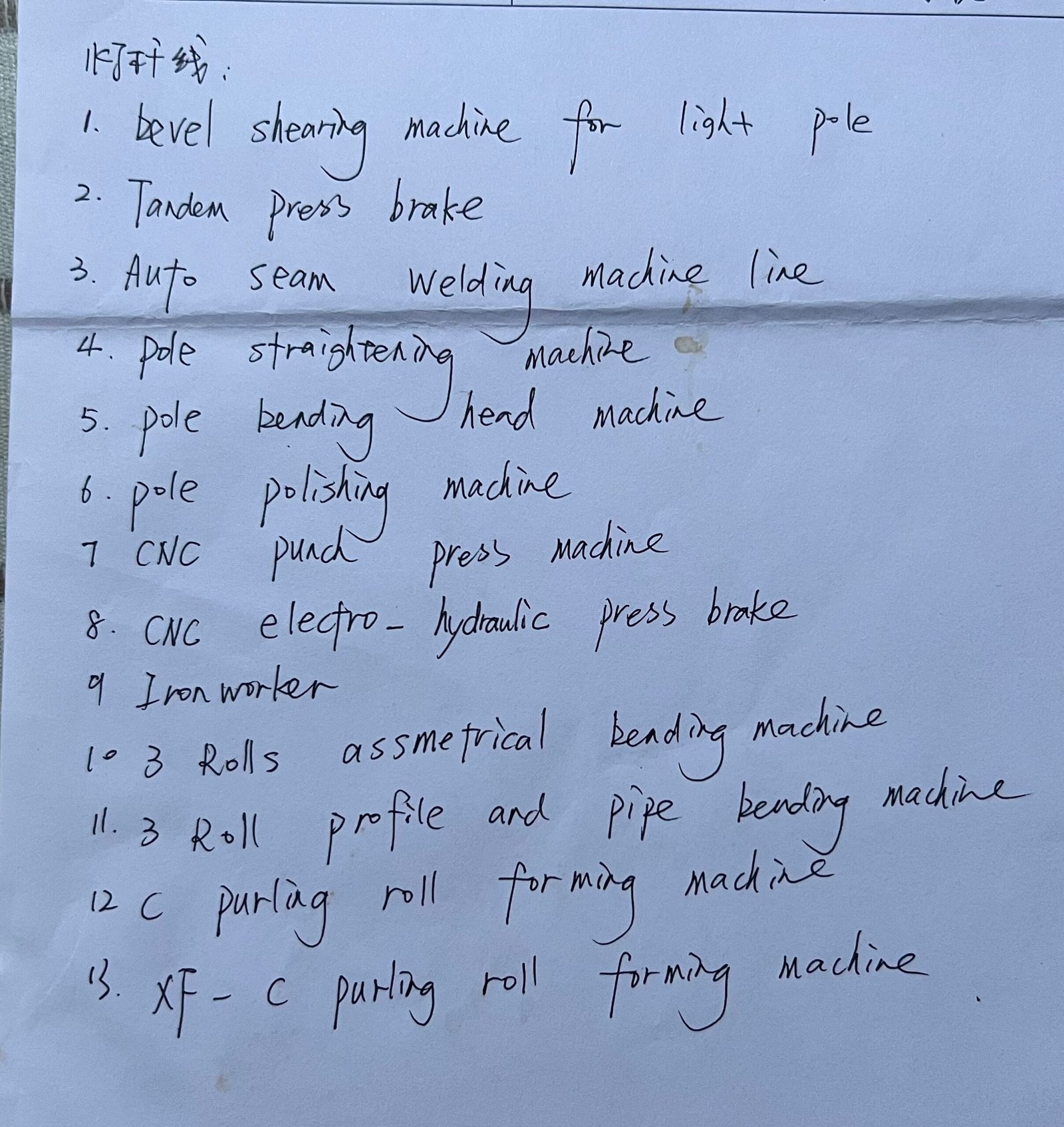
Around 2019, before the COVID pandemic, I sold 13 machines, as listed in the title of Burt. At that time, I worked in a small and greedy factory. They earn customer much money, give a standard machine and no after-sales. I will be sorry and leave later. Of course, there are also Ukraine JCO case leads. On oct.06,2025, i worte a letter to algeria customer, to say sorry, soon he reply two letter, one is say he never forget one friend. The other letter is in Chinese characters with one picture, showing I and he. So touch, why is some foreign even better than locals?
Here are the 13 machines he bought at that time: