Cut-to-Length Lines and Coil Slitting Lines: How They Work and How to Choose
Cut-to-length lines and coil slitting lines are two of the most widely used coil-processing systems in steel service centers, metal fabrication plants, construction-material factories and industrial production facilities.
Although both systems start with metal coils, they produce different finished products. A cut-to-length line converts a coil into flat sheets of a specified length. A slitting line divides a wide master coil into several narrower coils.
Choose a cut-to-length line when your final product is a flat sheet or plate. Choose a coil slitting line when your final product is a narrower strip or recoiled metal coil. The correct configuration depends on the material, thickness, width, coil weight, finished dimensions, required accuracy and production output.
Cut-to-Length Line and Slitting Line: What Is the Difference?
| Comparison | Cut-to-Length Line | Coil Slitting Line |
|---|---|---|
| Main purpose | Convert a metal coil into flat sheets of a specified length | Divide a wide coil into several narrower strips and recoil them |
| Finished product | Flat sheets or plates | Narrow metal coils or strips |
| Main process | Decoiling, leveling, feeding, length measuring, cutting and stacking | Decoiling, guiding, slitting, scrap winding, tension control and recoiling |
| Typical users | Sheet-metal factories, panel manufacturers, steel distributors and fabrication plants | Steel service centers, tube mills, roll-forming factories and strip-processing plants |
| Key selection factors | Sheet flatness, cutting length, cutting accuracy and stacking method | Strip width, number of strips, burr control, recoiling quality and tension control |
What Is a Cut-to-Length Line?
“`
A cut-to-length line, also called a CTL line, is designed to uncoil metal, remove coil set, measure the required length, cut the material and collect the finished sheets.
The system is commonly used for processing carbon steel, stainless steel, galvanized steel, aluminum and other coil materials. The machine configuration must be selected according to the actual material and production requirement.
Decoiling
Leveling
Length Measuring
Cross Cutting
Sheet Stacking
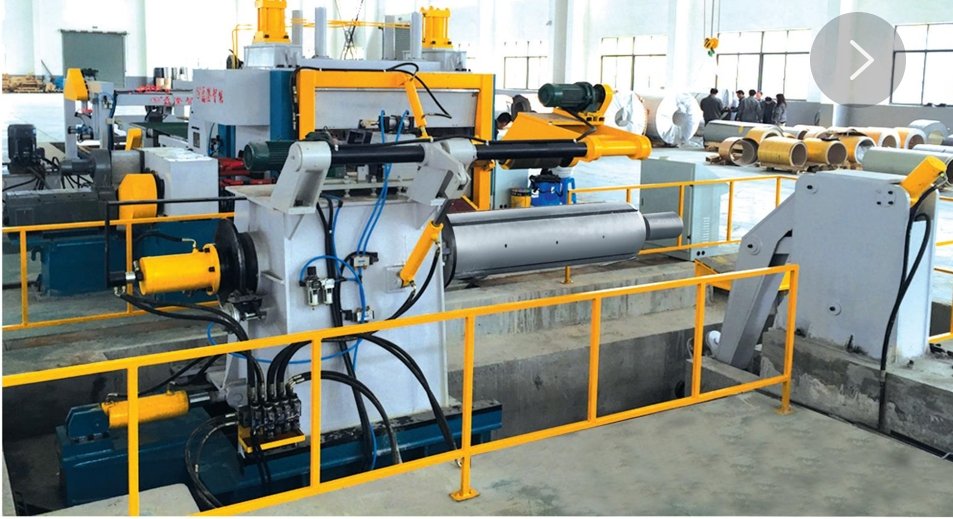
Cut-to-length line manufactured by Jiangsu Leicheng Intelligent Machinery and presented by Wendy Shen.
Main Sections of a Cut-to-Length Line
- Coil loading car: Loads and positions the coil for the decoiler.
- Decoiler: Supports the coil and controls the unwinding process.
- Feeding and guiding unit: Guides the material into the leveling section.
- Leveling machine: Reduces coil set, waviness and material deformation.
- Length measuring system: Controls the required finished-sheet length.
- Cross-cutting unit: Cuts the strip into individual sheets.
- Conveyor and stacker: Transfers and collects the finished sheets.
- Electrical control system: Coordinates the production sequence and operating parameters.
Where Are Cut-to-Length Lines Used?
Cut-to-length lines are used in steel service centers, electrical cabinet production, automotive component manufacturing, construction-material production, sheet-metal fabrication, appliance manufacturing and general industrial processing.
Light-gauge, medium-gauge and heavy-gauge materials require different machine structures. A line designed for thin sheet should not automatically be used for heavy plate, even when the working width appears similar.
What Is a Coil Slitting Line?
“`
A coil slitting line cuts a wide metal coil longitudinally into several narrower strips. The strips are then separated, controlled under tension and recoiled into finished coils.
Slitting quality depends not only on machine power. It also depends on the slitting-knife arrangement, knife clearance, material properties, tension control, separator setup and recoiler performance.
Decoiling
Guiding
Slitting
Scrap Winding
Tension Control
Recoiling
Coil slitting line overview showing the main production sections and material-processing sequence.
Main Sections of a Slitting Line
- Coil car and decoiler: Load, support and unwind the master coil.
- Entry guiding unit: Aligns the material before slitting.
- Slitting head: Uses rotary knives to divide the material into narrower strips.
- Scrap edge winder: Collects the trimmed edge material.
- Looping or buffering section: Helps coordinate speed and strip movement.
- Tension unit: Maintains stable strip tension before recoiling.
- Separator unit: Keeps individual strips correctly separated.
- Recoiler: Rewinds the finished strips into tight and orderly coils.
- Unloading car: Supports the removal of completed coils.
Where Are Coil Slitting Lines Used?
Slitting lines are commonly used by steel distributors, tube and pipe factories, roll-forming plants, transformer-material processors, roofing-material producers, metal-strip suppliers and automotive-parts manufacturers.
The required configuration changes significantly between carbon steel, stainless steel, aluminum, copper and electrical steel. Material strength and surface requirements must therefore be confirmed before quotation.
“`
How Do You Choose the Right Coil Processing Line?
“`
A useful quotation cannot be prepared from working width alone. The supplier must understand the complete production requirement.
For a Cut-to-Length Line, Confirm These Points
- Material type and material grade
- Minimum and maximum thickness
- Minimum and maximum coil width
- Maximum coil weight
- Coil inner diameter and outer diameter
- Required finished-sheet length
- Required cutting-length tolerance
- Required flatness after leveling
- Target production speed or daily output
- Required stacking and automation level
- Factory voltage and frequency
For a Slitting Line, Confirm These Points
- Material type, grade and tensile strength
- Coil thickness and width range
- Maximum master-coil weight
- Minimum finished-strip width
- Typical number of strips per coil
- Required strip-width tolerance
- Acceptable burr level
- Finished-coil inner diameter
- Required finished-coil tightness and edge alignment
- Required line speed and production capacity
- Surface-protection requirements
“`
Stop Shear, Rotary Shear or Flying Shear?
“`
The cutting method is one of the important decisions for a cut-to-length line.
- Stop shear: The material stops before each cutting cycle. It is often used when moderate speed and a simpler configuration are acceptable.
- Rotary shear: Rotary cutting can improve production continuity for suitable material ranges and applications.
- Flying shear: The cutting unit works while the material is moving. It is normally considered for higher-speed production, but requires a more advanced control system.
The most expensive option is not always the best option. The correct choice should balance material range, sheet length, output, accuracy, maintenance and investment budget.
“`
Why Is Leveling Performance Important?
“`
Leveling is not simply passing the sheet through several rollers. The roller diameter, roller spacing, number of leveling rolls, support structure, drive system and adjustment method all affect the final result.
Customers should clarify the original coil condition and the required flatness after processing. Materials with different thicknesses, yield strengths and surface conditions may need different leveling solutions.
“`
Machine Manufacturing and Overseas Project Coordination
“`
The coil-processing lines shown in these videos are manufactured by Jiangsu Leicheng Intelligent Machinery.
For overseas customers, Wendy Shen assists with requirement confirmation, factory communication, technical coordination, quotation follow-up, inspection arrangements and export-related communication.
Factory manufacturing, machine assembly, testing and project coordination.
“`
Frequently Asked Questions
“`
What is the main difference between a cut-to-length line and a slitting line?
A cut-to-length line produces flat sheets of a specified length. A slitting line produces narrower metal strips and recoils them into finished coils.
Can one machine perform both slitting and cut-to-length processing?
Combined lines are possible for some production requirements. However, the final configuration depends on the material range, finished-product sizes, production sequence, accuracy and expected output.
Can the line process stainless steel and aluminum?
Yes, suitable lines can be designed for stainless steel, aluminum and other metals. The machine structure, roller design, tooling, surface protection and control method must match the material.
What information is needed before receiving a quotation?
Please provide the material, thickness range, coil width, coil weight, coil inner and outer diameters, required finished dimensions, tolerance, output, voltage and automation requirement.
Can the machine configuration be customized?
Yes. Working width, thickness range, coil capacity, line speed, cutting method, control system, stacking method and other sections can be configured according to the confirmed production requirement.
Does the video show the exact machine that will be quoted?
Not necessarily. The videos introduce machine structures and production concepts. The final machine model and specification must be confirmed according to the buyer’s actual material and production data.
“`
Need a Cut-to-Length Line or Coil Slitting Line?
“`
Send your coil material, thickness, width, coil weight, required finished size and target output. We will coordinate with the factory to evaluate a suitable technical solution.
Machine Manufacturer:
Jiangsu Leicheng Intelligent Machinery
Overseas Inquiry & Project Coordination:
Wendy Shen
WhatsApp:
+86 150 0627 0003
Website:
www.cnsteelmachine.com