- 👉 “If you are not sure how to start, I can share a simple procurement checklist with you.”
-
Stage Task Responsible Time Requirement Confirm material & thickness Client 2 days Solution Select machine type Supplier + Client 3 days Quotation Compare suppliers Client 3-5 days Technical Final configuration Supplier 5 days Order Contract & payment Both — Delivery Production & shipping Supplier 30-60 days - How to Future-Proof Your Sheet Metal Factory
In sheet metal manufacturing, buying a machine is not only about meeting today’s production requirements. A good investment should also support tomorrow’s factory expansion, automation upgrade, and long-term production efficiency.
Many factories start with standard machines, such as fiber laser cutting machines, CNC press brakes, shearing machines, leveling machines, or coil processing lines. These machines may be enough for current orders. However, after a few years, production requirements often change.
The factory may need higher capacity, better accuracy, fewer operators, more automation, or better connection with digital production management systems.
This is why more manufacturers are now asking an important question:
How can we choose machines that will not become outdated too quickly?
This article explains how to future-proof your sheet metal factory before investing in new equipment.
1. Think Beyond Today’s Production
Many buyers only focus on their current product size, thickness, and daily output. This is understandable, but it can also limit future development.
Before purchasing sheet metal equipment, you should consider:
- Will your production volume increase in the next 3 to 5 years?
- Will you process thicker or wider material in the future?
- Will you need higher accuracy?
- Will labor cost become a bigger issue?
- Will you need automation later?
- Will your factory need to connect machines with production management software?
For example, a standard CNC press brake may be enough for simple bending today. But if your factory later needs robot bending, automatic tool change, or production data connection, a very basic configuration may become difficult to upgrade.
A future-proof machine does not mean you must buy the most expensive machine from the beginning. It means the machine should have reasonable upgrade possibilities based on your long-term production plan.
2. Choose Machines with Upgrade Capability
A machine with upgrade capability gives your factory more flexibility.
For sheet metal equipment, future upgrade capability may include:
- Robot loading and unloading interface
- MES or production management system connection
- Vision inspection option
- Remote diagnosis and online troubleshooting
- Automatic feeding or stacking option
- Advanced CNC controller
- Servo system upgrade
- Safety system upgrade
- Automation line integration
Not every factory needs all these functions immediately. However, if the machine can reserve the possibility for future upgrades, it can reduce modification cost later.
For example, when choosing a CNC press brake, you may not need a robot in the first stage. But if the controller, safety system, and machine structure can support future robot integration, the factory will have more options when production grows.
3. Plan the Whole Production Process, Not Only One Machine
A sheet metal factory is not built by one machine alone.
A typical sheet metal production process may include:
- Coil or sheet material preparation
- Leveling or straightening
- Laser cutting or shearing
- Deburring
- Bending
- Welding
- Inspection
- Surface treatment
- Assembly
If each machine is selected separately without considering the whole process, production bottlenecks may appear later.
For example:
- A fast laser cutting machine may create too many parts for slow manual bending.
- A press brake may have high accuracy, but poor sheet flatness may still cause angle variation.
- A coil processing line may have high speed, but stacking or material handling may become inefficient.
- A factory may buy several machines, but without clear layout planning, material flow becomes difficult.
To future-proof your factory, the equipment selection should follow the complete production process.
The key question is not only:
Which machine should I buy?
A better question is:
How will this machine work with the whole factory process?
4. Pay Attention to Automation Readiness
Automation does not always mean buying robots immediately.
For many factories, automation can be introduced step by step.
A practical automation roadmap may look like this:
Stage 1: Standard production
Manual loading, manual operation, basic machine configuration.
Stage 2: Semi-automation
Add servo backgauge, automatic feeding, automatic positioning, or automatic stacking.
Stage 3: Digital management
Connect production orders, machine status, cutting programs, or bending data with the factory management system.
Stage 4: Robotic or integrated production
Add robotic loading and unloading, robot bending, vision inspection, or automated production lines.
This step-by-step approach is more realistic for many medium-sized factories.
When selecting machines, buyers should check whether the machine can support future automation steps.
Useful terms include:
- Automation-ready
- Robot-ready
- MES-ready
- Remote diagnosis
- Expandable controller
- Future integration capability
These functions can make the machine more flexible for long-term factory development.
5. Consider MES and Production Data Connection
MES stands for Manufacturing Execution System. It helps factories manage production orders, machine status, operators, quality records, and production progress.
Not every sheet metal factory needs a full MES system immediately. But as production grows, digital management becomes more important.
A factory may need to know:
- Which order is being processed?
- Which machine is working?
- What is the production progress?
- How much material was used?
- Where did quality problems happen?
- How much downtime occurred?
If machines can connect with production management systems in the future, the factory will have better control over efficiency and quality.
This is especially useful for:
- Electrical cabinet factories
- Elevator panel manufacturers
- Steel furniture factories
- Automotive parts suppliers
- Large sheet metal workshops
- Steel service centers
Digital production management is becoming a major direction in modern manufacturing.
6. Do Not Ignore Remote Diagnosis and Online Support
For overseas buyers, after-sales service is a very important part of machine investment.
When a machine stops, the real cost is not only the repair cost. The bigger cost may be production delay, missed delivery time, and customer complaints.
Remote diagnosis can help reduce downtime.
For example, with proper configuration, the supplier or technical team may help check:
- Alarm information
- Controller settings
- Machine parameters
- PLC status
- Hydraulic or electrical problems
- Operation mistakes
Remote support cannot replace every on-site service requirement, but it can solve many basic problems faster.
For overseas customers, this is a practical and valuable future-ready function.
7. Compare Total Cost of Ownership, Not Only Purchase Price
A cheaper machine may reduce the initial investment, but it may not always reduce the total cost.
When evaluating sheet metal equipment, buyers should consider the total cost of ownership, including:
- Purchase price
- Installation cost
- Operator training
- Maintenance cost
- Spare parts availability
- Energy consumption
- Downtime risk
- Future upgrade cost
- Production efficiency
- Machine service life
A machine with better configuration may cost more at the beginning, but it may save more money during long-term operation.
For example, an upgrade-ready machine may help the factory avoid replacing the whole machine when future automation is needed.
This is why buyers should not only ask:
How much is the machine?
They should also ask:
How much will this machine cost and save during its full service life?
8. Choose the Right Level of Configuration
Future-proofing does not mean overbuying.
Not every factory needs the highest configuration. The correct configuration depends on the real production situation.
For a small workshop, a simple and stable machine may be enough.
For a growing factory, a mid-level configuration with future upgrade possibility may be better.
For a large manufacturer, automation, data connection, and high-end CNC control may be necessary from the beginning.
A practical comparison can be:
| Configuration Type | Suitable For | Main Advantage |
| Basic Configuration | Small workshops or simple production | Lower initial investment |
| Recommended Configuration | Growing factories | Balance between cost and long-term use |
| Upgrade-Ready Configuration | Factories planning automation or expansion | Better flexibility for future development |
The goal is not to buy the most expensive machine. The goal is to choose the machine that matches both current production and future growth.
9. Common Mistakes to Avoid
When planning a sheet metal factory upgrade, buyers often make these mistakes:
Only comparing machine prices
Price is important, but machine structure, controller, hydraulic system, tooling, safety, and after-sales support are also important.
Ignoring future production changes
A machine that is just enough today may become insufficient when production grows.
Buying machines separately without process planning
Each machine should fit into the complete production flow.
Ignoring software and data connection
Digital production management will become more important as factories grow.
Forgetting material handling
Loading, unloading, stacking, and internal logistics can become major bottlenecks.
Not checking upgrade possibility
Some machines are difficult or expensive to modify later.
Not discussing future plans with the supplier
A professional supplier should understand not only the machine requirement, but also the factory’s long-term production direction.
10. Key Questions Before Buying New Sheet Metal Equipment
Before purchasing new machines, buyers can prepare the following information:
- What products are you manufacturing?
- What material and thickness do you process?
- What is your current production capacity?
- What is your expected capacity in the next 3 to 5 years?
- Do you plan to reduce manual labor?
- Do you need automation in the future?
- Do you need MES or production data connection?
- Do you need remote diagnosis?
- What is your factory layout?
- What is your budget range for current and future investment?
With this information, the supplier can recommend a more suitable configuration.
Final Advice
Future-proofing your sheet metal factory is not about buying the most advanced machine immediately. It is about making smart equipment decisions that support current production and future development.
A good sheet metal machine should not only solve today’s production problem. It should also help your factory become more efficient, flexible, and ready for future automation.
Before buying a new machine, do not only compare price.
Compare:
- Production suitability
- Upgrade capability
- Automation readiness
- Maintenance convenience
- After-sales support
- Long-term value
A well-planned machine investment can help your factory reduce future modification costs, improve production efficiency, and stay competitive in the coming years.
If you are planning to upgrade your sheet metal factory, you can share your material, product photos, thickness range, capacity requirement, and future automation plan. We can help you check the suitable machine configuration and production solution.
Machine Combination Map
Electrical Cabinet
Laser → Press Brake / Panel Bender → Welding
General Sheet Metal Workshop
Shear → Press Brake → Plate Roller
Coil Service Center
Decoiler → Leveler → Slitting / CTL → Stacking
Pole Factory
Decoiling / Cutting → Press Brake → Welding → Straightening
Tank / Vessel
Cutting → Edge Preparation → Plate Rolling → Welding
AI Data Center → Power Distribution → Transformer / Switchgear → Electrical Cabinet → Cooling Equipment → Sheet Metal Fabrication → Metalworking Machinery
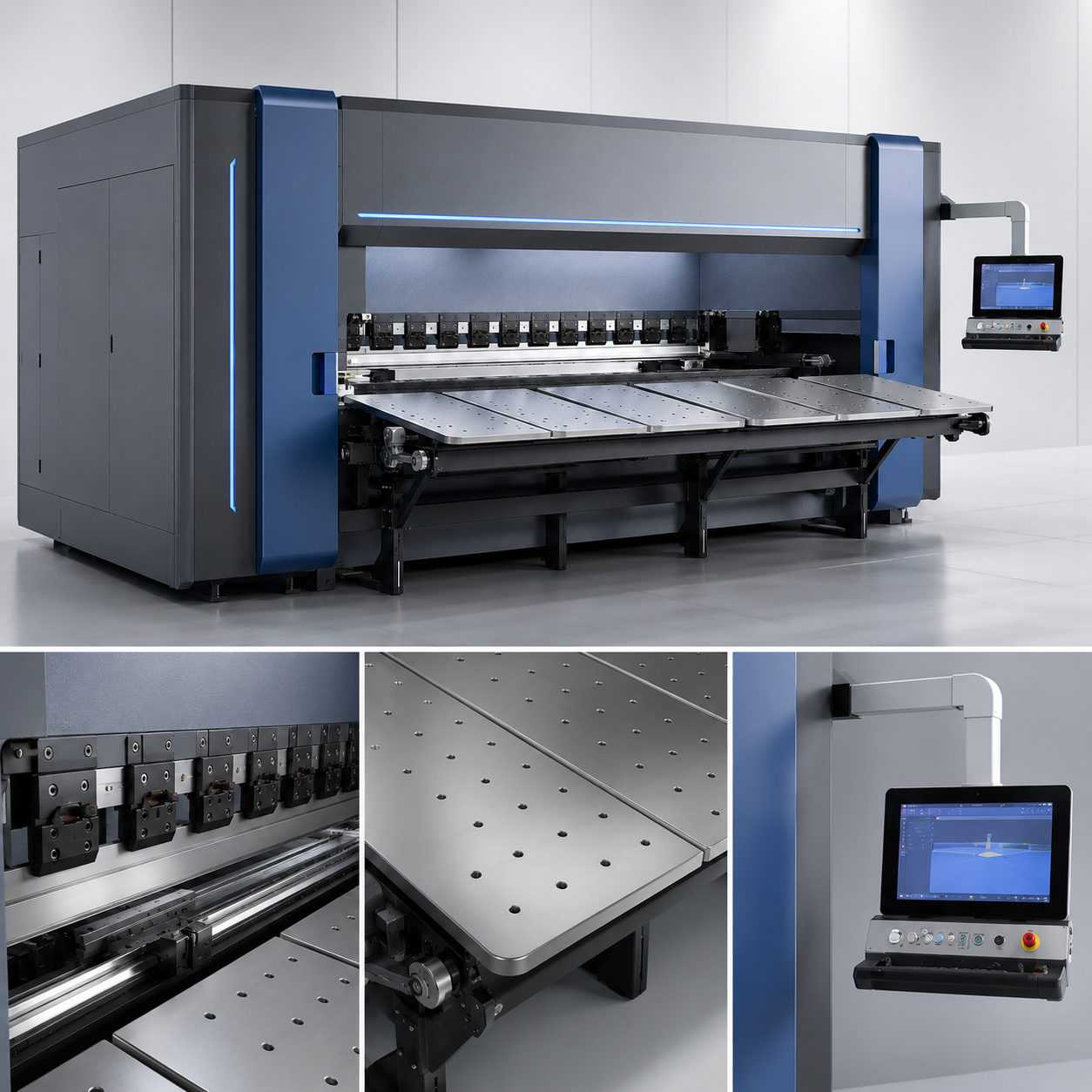
panel bender suitable for which industry:
- Electrical Cabinets
- Server Cabinets
- Elevator Panels
- HVAC Panels
- Kitchen Equipment
- Metal Furniture
- The common characteristics are:Thin sheet metal + multi-stage bending + repetitive production + high sensitivity to labor reliance.
Electrical Cabinet。
Raw Sheet / Coil
↓
Leveling / Cutting
↓
Laser / Punching
↓
Bending
↓
Welding
↓
Surface Treatment
↓
Assembly
when Bending,has two choose:
CNC Press Brake
vs
Panel Bender