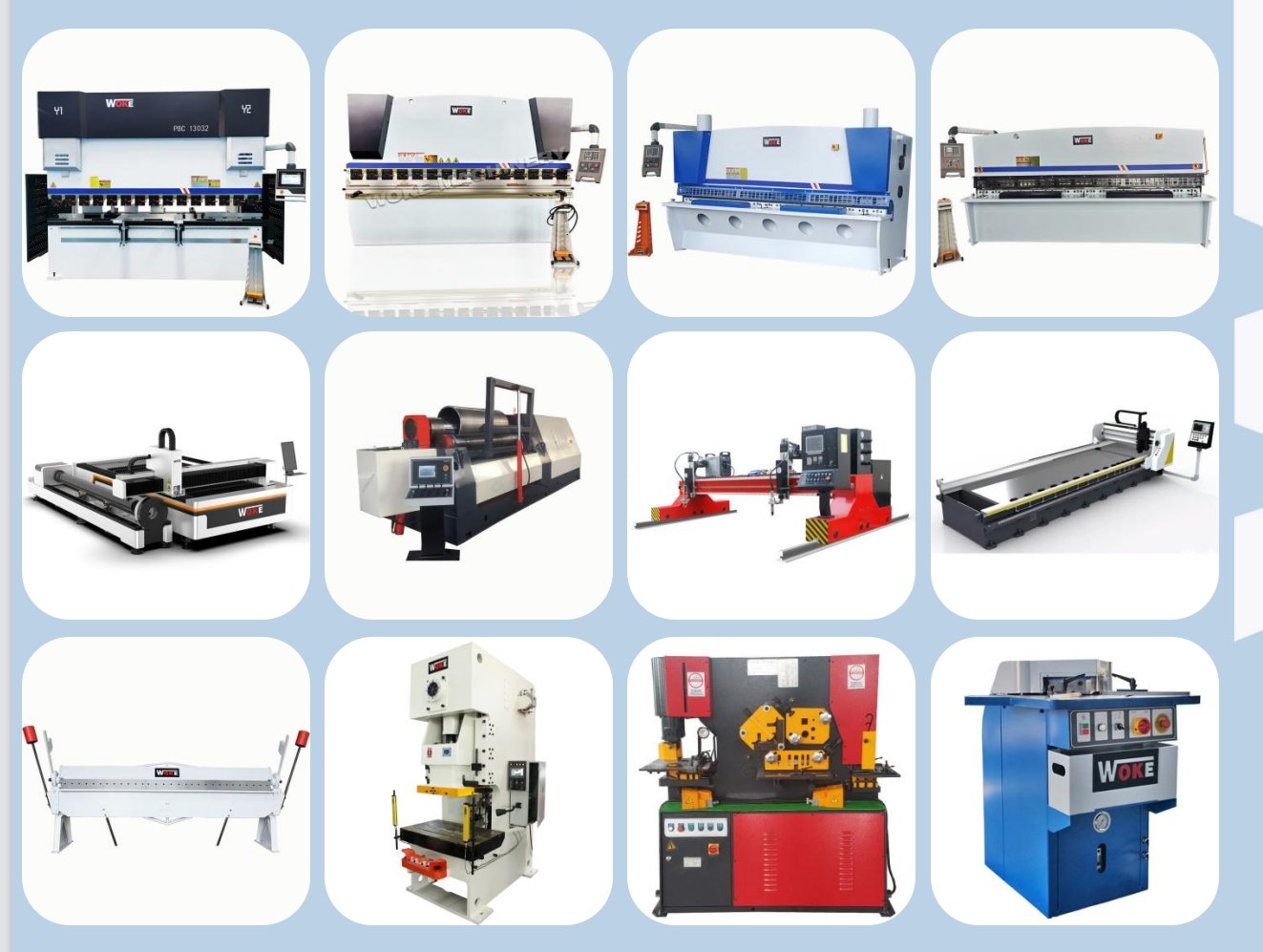
“Metal sheet machines” are machines used to process flat metal sheets — cutting, bending, forming, or finishing them into specific shapes and products.
Here’s a clear breakdown 👇
🔧 1. Cutting machines
Used to cut large metal coils or sheets into smaller sizes.
- Shearing machine – cuts straight lines.
- Slitting line – cuts coils into narrow strips.
- Cut-to-length line – uncoils, levels, and cuts sheets to required lengths.
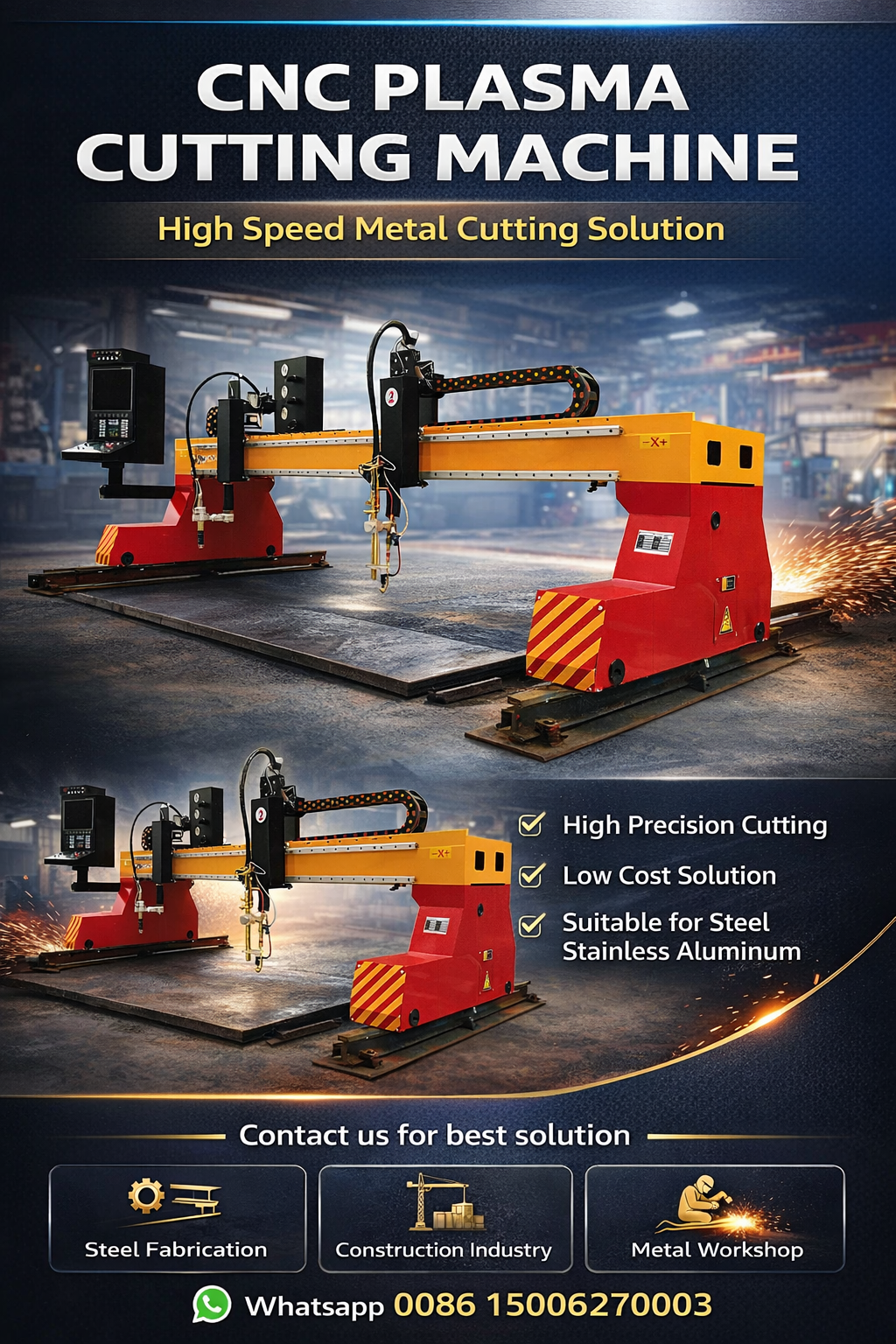
- Laser/plasma cutter – for precision contour cutting.
🧱 2. Forming and bending machines
Used to shape flat sheets into three-dimensional parts.
- Press brake – bends metal sheets into angles.
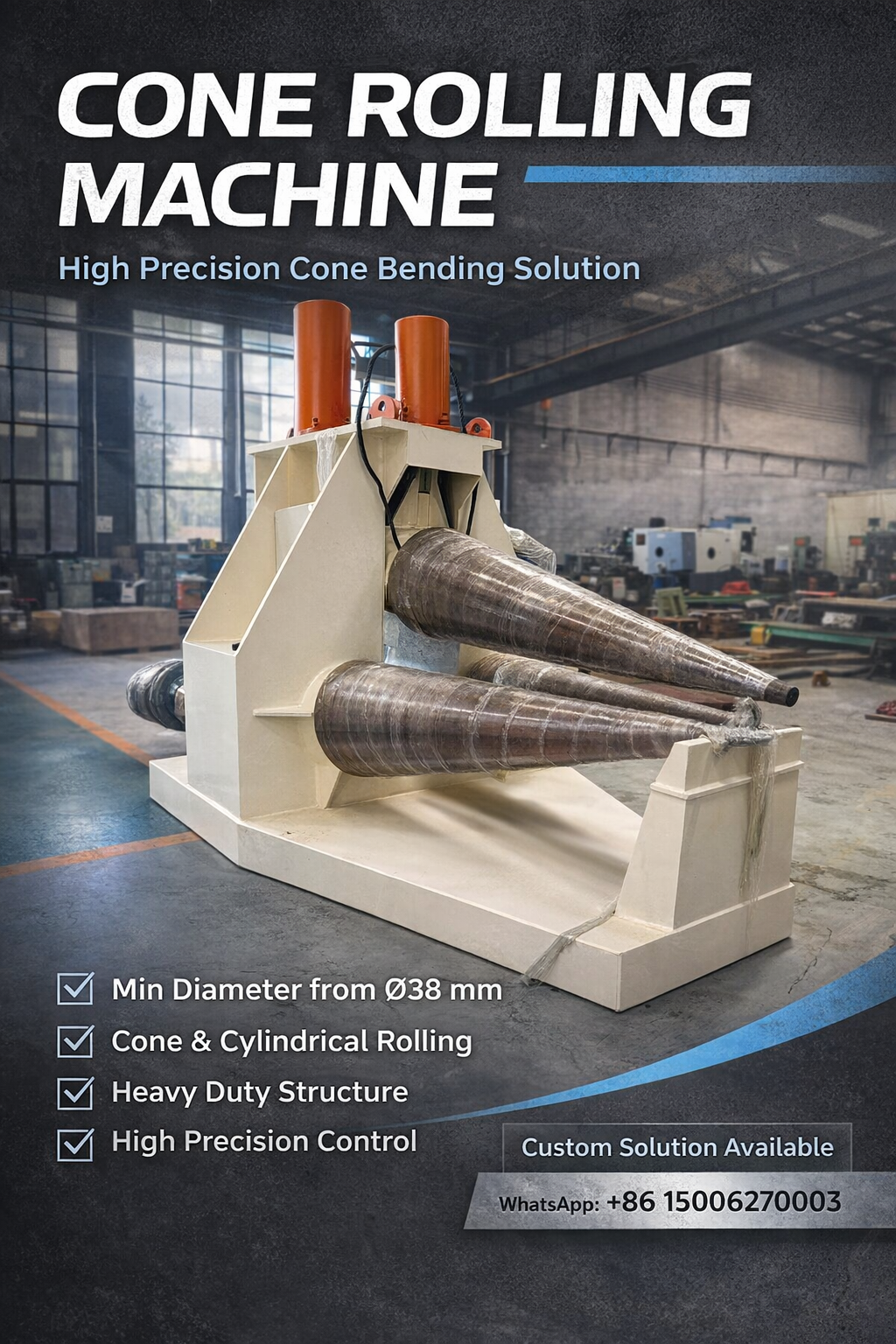
- Rolling machine (plate roller) – rolls sheets into cylinders or cones.
- Ironworker – punches, notches, and shears sections.
⚙️ 3. Leveling and straightening machines
Make sure sheets are flat and free of stress before use.
- Leveling machine / straightener – corrects coil curvature.
- Uncoiler and feeder – feeds material into production lines.
🏭 4. Production lines (integrated systems)
For large-scale industrial production.
- Light-pole production line
- Pipe forming or JCO pipe line
- Steel door or cabinet production line
📦 5. Applications
Metal sheet machines are used in:
- Construction and building materials
- Power pole, transformer, and energy industries
- Vehicle, appliance, and equipment manufacturing
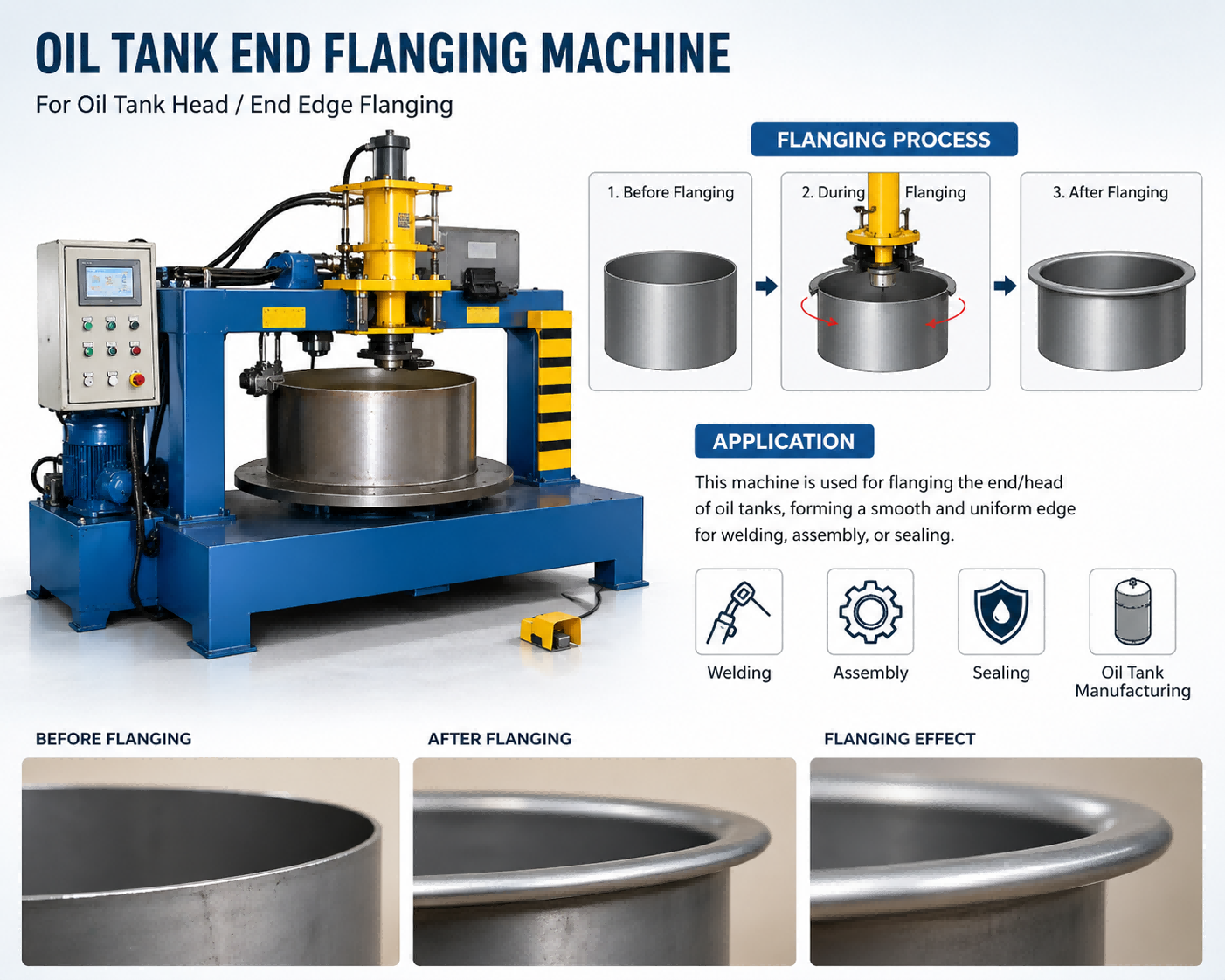
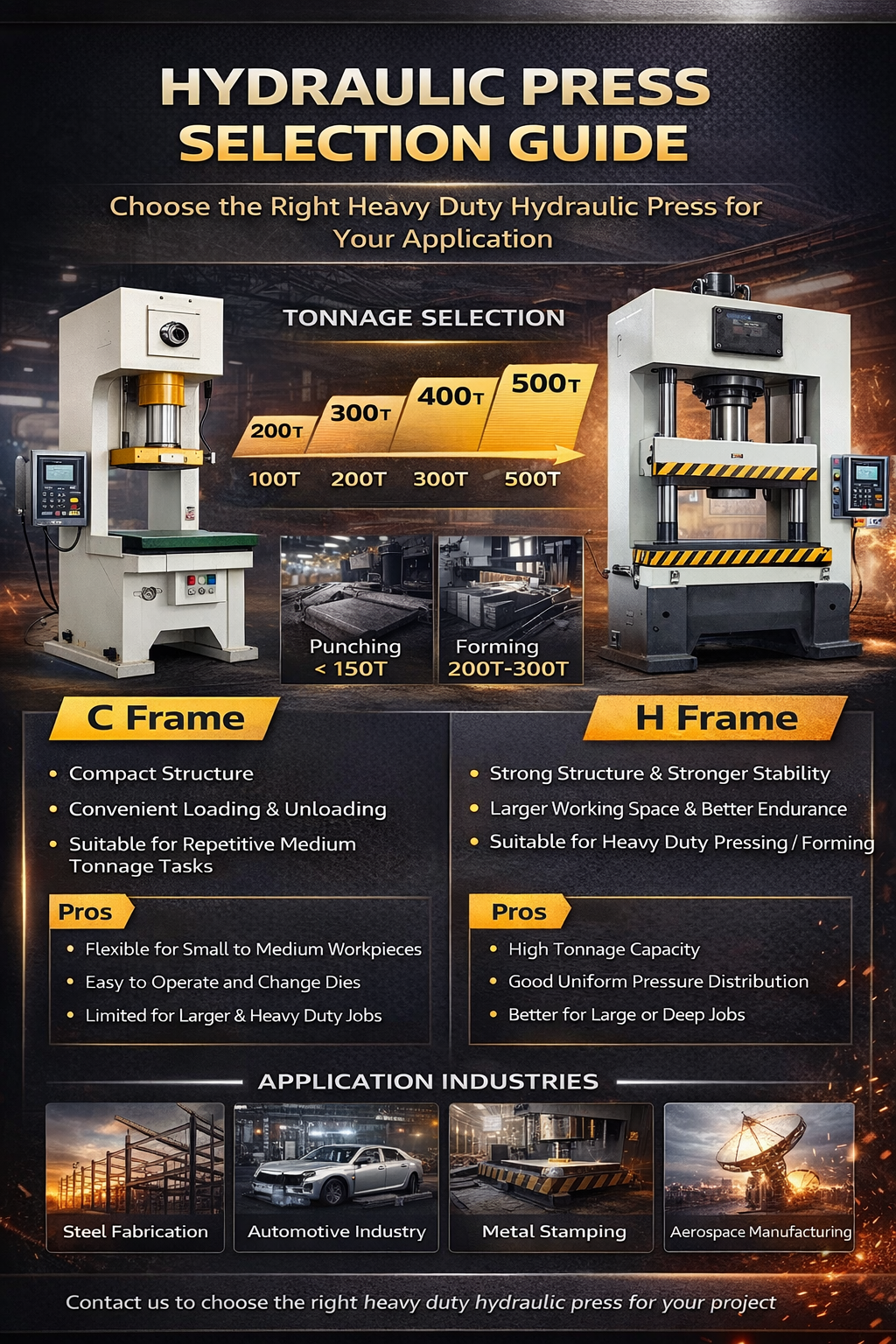
oil tank end flanging machine
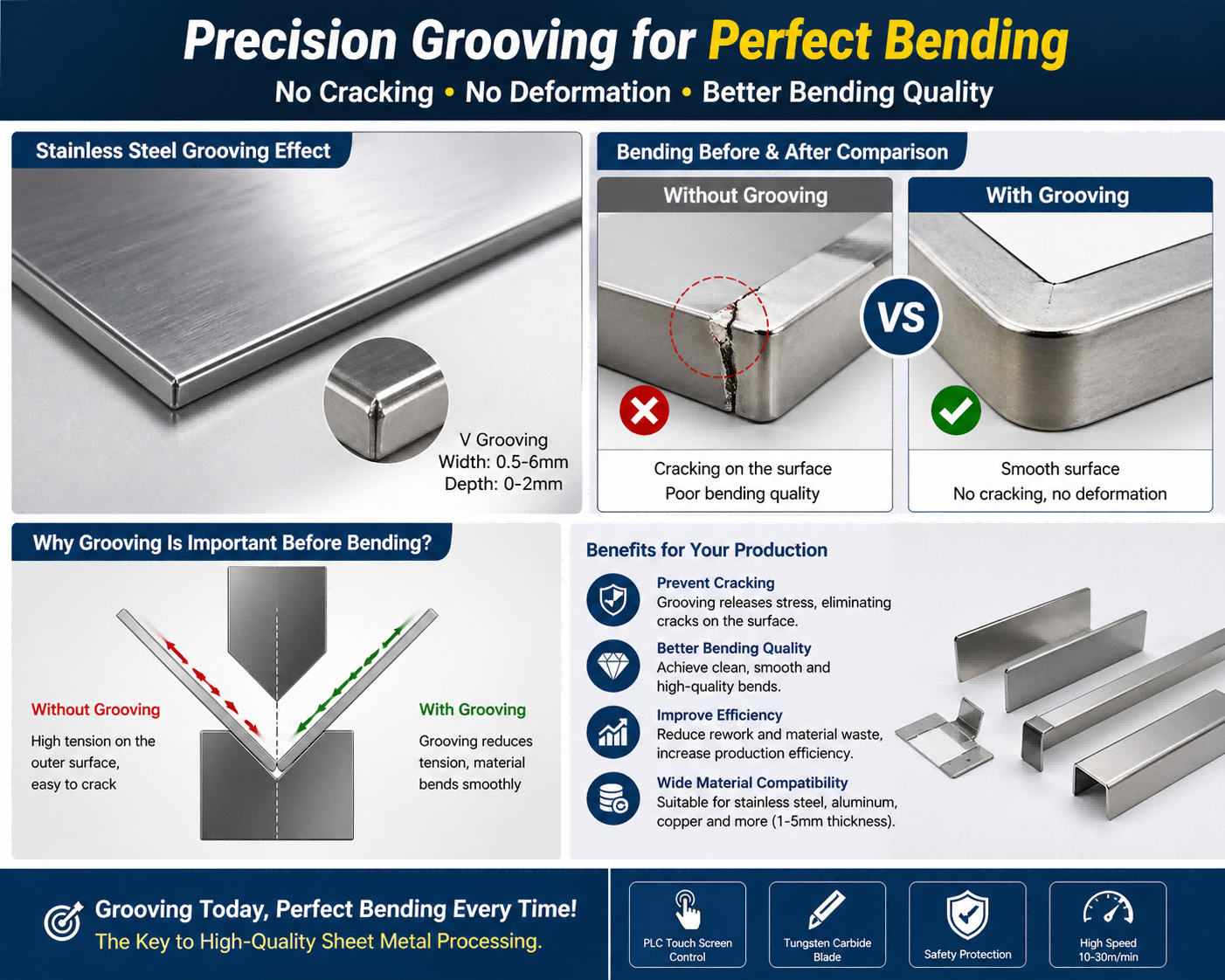
Why is grooving needed for metal sheet bending sometimes
grooving machine
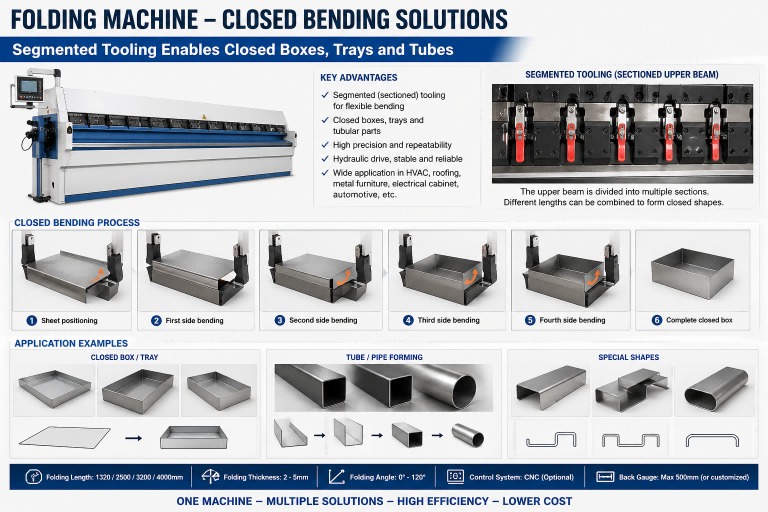
how to use panel bender to bend metal sheet into box
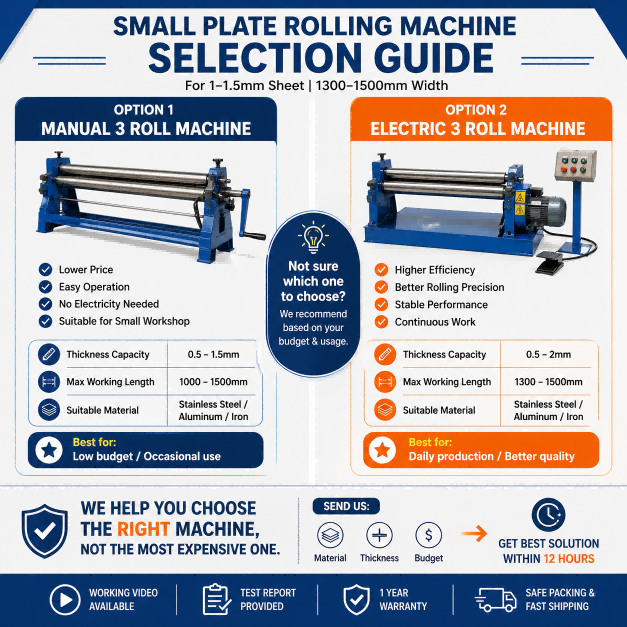
how to select small plate rolling machine
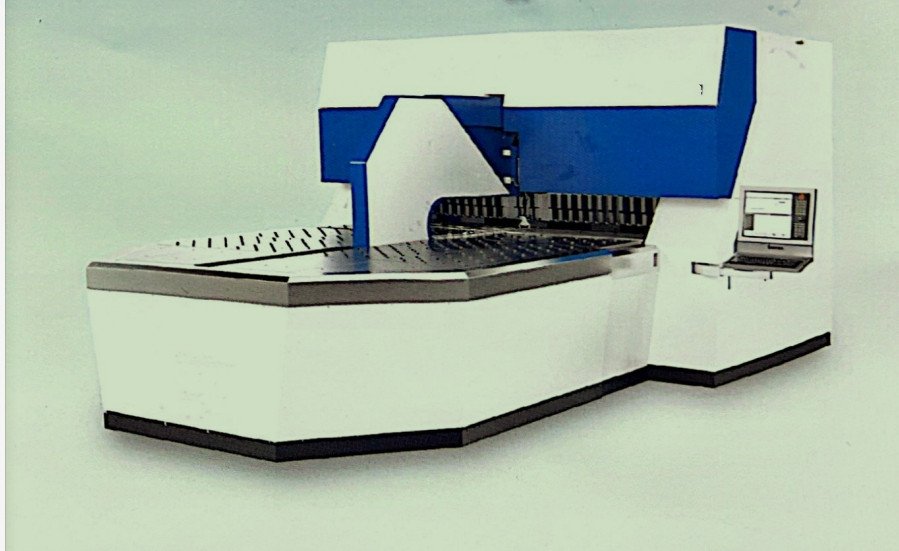
CNC Universal Panel Bender with Automatic Tool Changer
This high-performance universal panel bender is designed for manufacturers who need consistent quality, high flexibility and a reliable CNC panel bending machine for sheet metal production.
With a full-touch HMI, servo-driven clamping and an advanced Germany BECKHOFF CNC system, it delivers precise, efficient and energy-saving panel bending for a wide range of applications.
Key Advantages of Our Panel Bender
- Full-touch CNC control: User-friendly HMI with powerful industrial control for quick setups and stable production.
- Automatic tool change: Smart tool-change system significantly reduces downtime and supports flexible, small-batch production.
- Servo-driven clamping: Mechanical servo clamping provides stable sheet control, accurate positioning and high repeatability.
- Energy-efficient operation: Low noise, low power consumption and environmentally friendly design.
- Flexible configuration: Suitable for various materials, thicknesses and complex part geometries.
Machine Structure & Bending Performance
High-Rigidity Frame and Transmission
The machine body is integrally cast with high rigidity and optimized using finite element analysis.
A servo motor with a low-backlash planetary reducer and heavy-duty high-precision lead screw drives the folding beam along the programmed path,
ensuring accurate bending angles and stable long-term performance.
Advanced Mold & Tooling System
- Compression molds: Quenched and precision-ground mold bases secure accuracy and consistency across large production volumes.
- Hinged molds for complex parts: Ideal for workpieces with complex shapes and edges, compensating for limitations of fixed compression molds.
- Short mold devices: Support partial folding, wrinkle forming and open-edge bending, significantly expanding bending capabilities.
- Automatic tool changer: Enables fast tool and size adjustment, keeping the panel bender productive even during frequent job changes.
Positioning, Feeding & Press Foot
The positioning device (pressing rod) supports chamfer positioning and edge positioning, and is fully automatic and safe to use.
The rotary feeding mechanism offers servo-controlled mechanical pressing and full-sheet clamping, with built-in guide rails to guarantee high speed, high accuracy and stable motion.
Multiple press-foot designs are available to match different materials and part sizes. Non-metallic press feet can be selected for scratch-sensitive surfaces,
making the machine suitable for high-end sheet metal products, cabinets, enclosures and decorative panels.
Germany BECKHOFF CNC System
- Optional 15″ / 17″ color touch display
- Storage capacity for more than 20,000 programs with USB backup
- Offline programming with 2D bending simulation and contour programming (optional)
- Automatic calculation of pressing force, stroke and safe working areas
- System diagnostics and a complete bending process model library
- Supports hinged molds and automatic tool change for different bending tasks
- Full servo-electric control for efficient and energy-saving operation
Typical Applications
This CNC panel bender is ideal for:
- Sheet metal cabinets and enclosures
- Doors, panels and frames
- HVAC and ventilation components
- Electrical boxes and control panels
- Furniture parts and architectural metalwork
Why Choose Our Panel Bending Machine?
- Stable and reliable structure with long service life
- High flexibility for small-batch and multi-variety production
- Short setup time thanks to automatic tooling and CNC control
- Consistent bending quality with built-in compensation functions
- Professional technical support and customized solutions
FAQ: Universal Panel Bender
1. What is the main advantage of a CNC panel bender compared with a traditional press brake?
A CNC panel bender automates the bending sequence with a folding beam and automated tooling, making it very efficient for panels, boxes and repeat jobs.
It provides fast setup, high repeatability and easier operation for complex bending tasks compared with a traditional press brake.
2. Can this panel bender handle different materials and thicknesses?
Yes. The servo-driven clamping system and configurable tooling allow the machine to work with different sheet materials and thickness ranges,
as long as they are within the specified technical parameters.
3. Is the automatic tool change suitable for frequent product changes?
Absolutely. The automatic tool changer is designed for workshops that need to switch between different part sizes and bending programs quickly,
helping you reduce non-productive time and improve overall throughput.
How to choose a right laser pretection guide for press brake
Multi-Level Safety Architecture
Implements redundant SIL 3 (ex Category 4) safety circuits for fail-safe operation
Combines DSPAP+MCS and DSPEX+MCS EX technologies for real-time hazard detection
Features ≤5ms response time for instant beam interruption
Environmental Robustness
IP65-rated enclosures (dust-tight & water-resistant) for harsh industrial environments
Stable performance across temperatures -10°C to +55°C
Enhanced Optical Safety
CLASS 1M laser classification compliance
15m maximum protection distance with 5mm detection accuracy
Multi-sensor photoelectric receivers for beam path monitoring
Operational Intelligence
Integrated LED status indicators for real-time system diagnostics
Valve direct-drive output for immediate safety shutdowns
Safety pedal integration for emergency manual override
Recommended Visuals
Based on the comparison table in , these diagrams would enhance understanding:
Visual Type Purpose
Performance Comparison Matrix Side-by-side specs of DSPAP+MCS vs DSPEX+MCS EX systems (adapt Fig.1 from )
Safety Architecture Diagram Layer-by-layer illustration of SIL3 safety circuits and redundancy design
Detection Range Schematic Visualize 15m protection radius with sensor coverage zones
Component Layout Exploded view showing LED indicators, valve drivers, and safety pedal interfaces
💡 Design Tip: Use color-coding to differentiate protection levels (e.g., red=emergency stop, yellow=warning, green=operational)
Implementation Guidance:
Prioritize SIL3-certified modules for high-risk applications
Configure multi-sensor arrays every 5m for full coverage in large facilities
Combine with physical barriers (≥5mm thickness) where reflected beams pose risks
LASER CUTTING MACHINE
Glass Substrate Processing: From Advanced Materials to Precision Laser Micromachining
Glass substrates are emerging as an important technical option for next-generation Mini LED backlight systems. Their high surface flatness, dimensional stability, electrical insulation and low coefficient of thermal expansion make them particularly suitable for applications requiring dense circuit layouts, high numbers of local-dimming zones and reliable performance under changing temperatures.
Compared with conventional organic circuit-board materials, glass can provide better resistance to warping and more stable dimensional control during high-temperature processing. These properties make it possible to create finer circuit patterns and support more densely integrated LED arrays.
Advances in Glass Substrate Materials
Recent developments have focused not only on the processing of glass, but also on the composition of the glass itself.
By adjusting the proportions of oxides in the glass formulation, manufacturers can optimize important characteristics such as thermal expansion, thermal conductivity, mechanical stability and compatibility with LED packaging processes.
For example, newly developed glass-based Mini LED substrate materials use carefully controlled oxide compositions to improve dimensional stability during high-temperature packaging. Better thermal and dimensional performance can reduce substrate deformation, improve packaging consistency and support reliable light-emitting performance.
Ultrafast Laser Drilling for Glass Substrates
Precision hole formation is one of the most challenging stages in glass-substrate manufacturing.
Traditional mechanical drilling can create chipping, edge cracks and hidden microcracks because glass is a hard and brittle material. These defects become increasingly difficult to control as the glass becomes thinner and the required holes become smaller.
Picosecond and femtosecond lasers offer an alternative processing method. Their extremely short pulse durations allow energy to be delivered to a highly localized area before significant heat can spread into the surrounding material.
This process is often described as low-heat or “cold” laser processing. It can provide:
- Micron-scale hole diameters
- Reduced heat-affected zones
- Less chipping around hole edges
- Lower risk of thermally induced cracking
- Improved control of hole taper
- Higher positioning accuracy
- Greater flexibility for complex hole patterns
Depending on the substrate material and process configuration, ultrafast lasers may be used for direct ablation or combined with selective laser modification and chemical etching.
Through-Glass Vias and High-Density Interconnection
Microholes formed in a glass substrate can subsequently be metallized to create through-glass vias, commonly known as TGVs.
TGV technology allows electrical connections to pass through the glass, supporting high-density interconnection, compact packaging and shorter signal paths. Potential applications include:
- Mini LED and Micro LED displays
- Advanced semiconductor packaging
- Glass interposers
- MEMS devices
- Sensors
- Radio-frequency components
- High-density electronic modules
The quality of a TGV depends on more than hole diameter alone. Manufacturers must also control the aspect ratio, taper angle, entrance and exit quality, sidewall condition, hole-to-hole consistency and metallization reliability.
Processing Ultra-Thin Glass
Ultra-thin glass requires particularly careful handling and motion control.
As substrate thickness decreases, vibration, thermal stress and uneven clamping can cause breakage or distortion. A precision processing system therefore needs more than an appropriate laser source. It may also require:
- High-accuracy motion stages
- Stable vacuum or non-contact positioning
- Automatic focusing and height compensation
- Optimized laser scanning paths
- Real-time process monitoring
- Machine-vision alignment
- Effective debris extraction
- Controlled loading and unloading
These factors become increasingly important when processing ultra-thin glass or large-area substrates.
Selective Processing of Glass–Metal Structures
Advanced electronic substrates may contain glass, conductive films and metal layers in the same structure.
By selecting an appropriate laser wavelength, pulse duration and energy density, manufacturers can remove or modify one layer while minimizing damage to the adjacent material. This selective processing capability is useful for circuit patterning, coating removal, via formation and the production of glass–metal composite structures.
However, the processing window must be carefully controlled. Excessive energy can damage the metal layer or create cracks in the glass, while insufficient energy may result in incomplete material removal.
Embedded Circuits and Improved Electrical Reliability
Glass can also be used as an insulating carrier for embedded or semi-embedded circuit structures.
Grooves can be formed in the glass surface and subsequently filled or coated with conductive material. Because glass has high electrical insulation and low moisture absorption, it can help reduce unwanted electrical migration between adjacent conductors.
This structure may also reduce some of the reliability problems associated with gaps, uneven surfaces and insulating coatings in conventional circuit-board manufacturing.
What This Means for Precision Equipment Manufacturers
The development of glass substrates demonstrates how modern manufacturing is moving from conventional cutting and drilling toward highly controlled material processing.
Successful glass-substrate production requires the integration of several technologies:
- Ultrafast laser sources
- Precision motion-control systems
- Optical focusing and beam-delivery systems
- Machine vision
- Process-control software
- Automated material handling
- Inspection and quality-control equipment
The key challenge is not simply producing a small hole. It is producing thousands or millions of consistent features without damaging a fragile substrate.
For buyers evaluating glass laser drilling or micromachining equipment, the most important parameters include substrate material, glass thickness, required hole diameter, hole quantity, aspect ratio, allowable chipping, taper tolerance, positioning accuracy and target production capacity.
A technically reliable quotation should therefore be based on actual samples, drawings and production requirements rather than on laser power alone.
Looking for Precision Laser Processing Equipment from China?
Selecting a glass laser drilling or precision micromachining system requires more than comparing laser power and machine prices.
The final equipment configuration must be matched to the substrate material, thickness, hole geometry, production volume, quality requirements and downstream process.
Wendy Shen helps overseas customers identify and coordinate with suitable Chinese machinery manufacturers. The service may include requirement clarification, supplier screening, technical communication, quotation comparison, factory visits, sample-processing coordination and pre-shipment inspection.
To evaluate a project, please provide:
- Glass material and substrate dimensions
- Glass thickness
- Required hole diameter and tolerance
- Blind-hole or through-hole requirements
- Hole quantity and layout
- Required production capacity
- Sample drawings or processing files
- Acceptable chipping and heat-affected area
- Plant voltage and destination country
The more complete the production information, the more accurately the equipment configuration and project budget can be evaluated.